European Family Businesses Newsletter # 31
EFB publications & policy work
Business Transfers tax regime before and after 1994
In May 2025, in order to analyse the impact of the 1994 business transfers recommendation, we assessed the state of play in some Member States such as Germany, Belgium, the Netherlands, Spain, Finland and the United Kingdom where these exemptions are currently being called into question. We also looked at Italy, Portugal and Sweden, which have taken a different approach to the business transfer topic. The comparisons between the systems in place and the changes that occurred helped us to make the case that Articles 6 and 7 of the 1994 recommendation ought to remain the same in the updated recommendation.
For the full paper visit EFB’s website here.
Generational Renewal in the Agricultural Sector
In July 2025, EFB supported the European Landowner Organization’s (ELO) submission to a call for evidence issued by the European Commission on the topic of Generational Renewal in the Agricultural sector. The Commission has identified in the Vision for agriculture and food the risks facing the agricultural sector in particular pertaining to the aging of farmers noting that only 12% of farmers are under the age of 40 and the complexities with the intra-family business transfer in the sector.
Visit ELO and EFB’s submission to the call for evidence here.
Visit the European Commission’s website on the Vision of agriculture and food here.
28th regime for innovative companies
In May 2025, the Commission highlighted its intention to develop a 28th regime for innovative companies as part of the start-up and scale-up strategy. In September 2025, EFB published its contribution to the Commission’s call for evidence asking for the following suggestions to be considered:
- The 28th regime ought to be available to all companies (not just limited to innovative startups) to opt- into on a voluntary basis,
- It should be designed with proportionality and the once only principle in mind and ensure that it complements the Single Market.
- It needs to offer a level playing field for companies within and outside of it,
- It should be a available in all European languages,
- Digital by design should be the default.
We also suggested that a pan-European Labour law should be considered to promote a consistent labour flow within the Single Market, provided the social security complexities are addressed upfront.
You can find our full contribution to the call for evidence here.
Future-Proofing the EU Single Market: Closing the skills gap and unlocking labour mobility
In October, we published a position paper discussing the skills gaps and labour mobility challenges felt by Europe’s businesses. In this paper we listed our priority recommendations for tackling the challenge of skills shortages and labour mobility within the Single Market.
You can find our full paper here.
EFB events and policy-related meetings
EFB’s 11th Family Business Summit – Lisbon
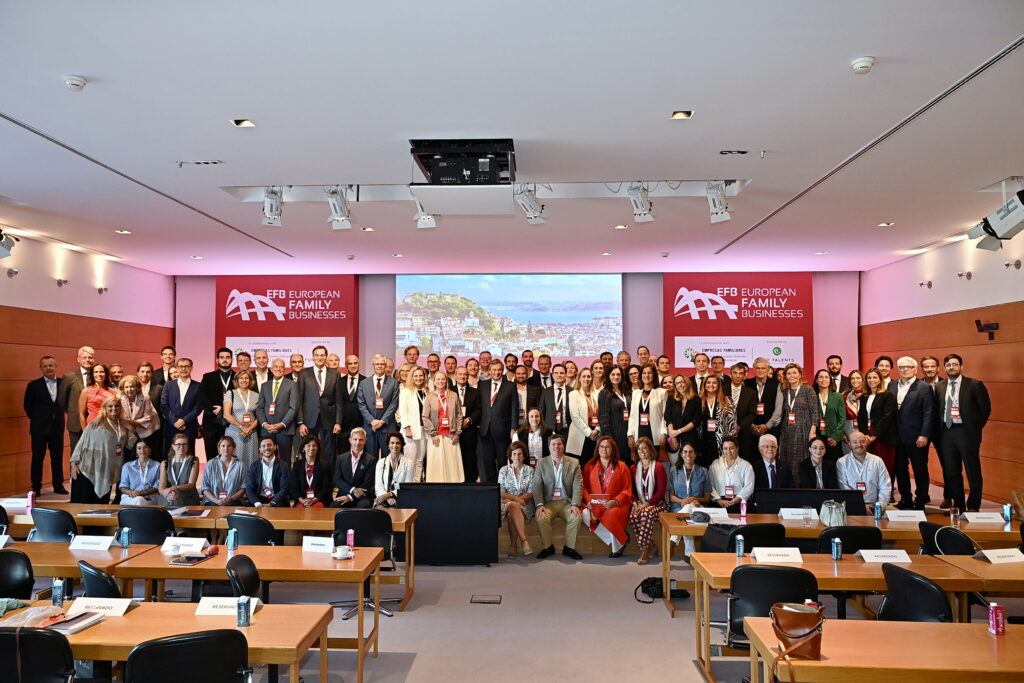
Between 13 and 14 October 2025, European Family Businesses held its 11th Summit under the title of Unleashing the Power of Family Businesses for A Stronger Europe. The summit was held in Lisbon in collaboration with our Portuguese chapter Associação das Empresa Familiares (Association of Portuguese Family Businesses). This was the third time we held our yearly gathering in Lisbon.
Our goal was to demonstrate how family businesses shape not only the communities in which they are founded, but also Europe’s economy at large. Thus, we analysed the challenges faced by family businesses in the current geopolitical landscape.
We had more than 120 attendees from 15 nationalities. Our summit began with an opening address by José Germano de Sousa, President of the Association of Portuguese Family Businesses, which was followed by a speech from Günther H. Oettinger, former Vice-President of the European Commission, and an excellence award conferred by the Association of Portuguese Family Businesses to the “family business of the year” to the de Mello Family. We also had a keynote speech by Joaquim Miranda Sarmento, Portuguese Minister of State and Finance, who offered a detailed analysis of the changing economic situation in Portugal.
For the full event overview, visit our website here.
Meetings with EU representatives
Over the last six months 2025, EFB had several meetings with members of the European Parliament and the European Commission. Below is an overview of some of the meetings we had.
In 6 October, following an SME Envoy Network meeting in Brussels, EFB had a meeting with Ms Marie-Helene Pradines the Head of Unit for SMEs to discuss the upcoming business transfer recommendation. Here we spoke specifically of how the recommendation enabled family businesses to flourish over the last thirty years and reiterating the importance of keeping the essence of the recommendation as is.
On 7 October, EFB representatives Mr Jesús Casado, EFB’s Secretary General, Ms Joana Peixinho, Policy Advisor and Mr Darius Movaghar Senior Policy Advisor had a meeting with Ms Gabriela Tschirkova, Member of the Cabinet of Commissioner Dombrovskis. During this meeting we discussed the topics of business transfers, family business statistics and Small Mid-Caps.
On 10 December, EFB’s President Mr Jan K. van Oord and Mr Casado, EFB’s Secretary General and Ms Peixinho, Policy Advisor had a meeting with members of DG GROW. In this meeting with the Head of Unit for SMEs Ms Marie-Helene Pradines and Mr Pier Francesco Sammartino we discussed the updated recommendation on Business Transfers that we, along with other business associations have been calling for and contributing to, the Small Mid-Caps (SMCs) definition proposed by the European Commission in May 2025 and Omnibus I’s simplification of the Corporate Sustainability Due Diligence Directive (CSDDD) and the Corporate Sustainability Reporting Directive (CSRD).
Between 10 and 12 November, Mr Casado and Ms Peixinho, attended the European Commission’s SME Assembly in Copenhagen. Here we discussed a myriad of topics, but most notably the topic of business transfers. We also attended many interesting policy discussions on entrepreneurship, digital support tools for SMEs, Competitiveness, better regulation, net zero and more. We thank the European Commission’s DG GROW for the opportunity to discuss these topics.
A word from one of our chapters:
Family Business Office Malta
Malta’s Family Business Office: A Landmark Year and a Bold Vision Ahead
2025 marked a transformative year for Malta’s family businesses. Through strategic partnerships and innovative support, the Family Business Office (FBO) strengthened its mission to help family enterprises thrive for generations.
Over the past year, we significantly strengthened our team and impact. We welcomed Joseph F. Portelli as Senior Manager and Marisabelle Grech as Head of Marketing. Their energy helped increase FBO registrations by 7%, as more businesses took advantage of the tangible benefits and formal recognition offered under the pioneering Family Business Act. This growth reflects increasing confidence in the Family Business Act and its benefits, with over 15 new businesses joining the register.
A key highlight of the last six months was the highly successful Gozo Family Business Forum, held in November. The event, which welcomed the Minister for Gozo, brought together family business owners and Corporate Service Providers (CSPs) for two insightful panels. These sessions explored the complexities of running a family enterprise and the specific incentives available, featuring representatives from partner entities as well as established family business owners. The forum also offered valuable networking opportunities and dedicated one-on-one sessions with FBO representatives, allowing attendees to address their specific questions. Our outreach efforts, in collaboration with Invest Gozo, the Gozo Chamber of SMEs, the Malta Chamber of Commerce, and Malta Enterprise, ensured that family businesses across the islands were aware of the tailored support systems available to them.
In 2025, the FBO proudly represented Malta at the Transeo Summer Summit in Padova, Italy, and the European Family Businesses (EFB) Summit in Lisbon. These events allowed us to share best practices and reinforce Malta’s position as a leader in family business policy. Our participation reinforced Malta’s leadership in succession planning and highlighted our innovative legal framework as a model for Europe.
While the European Commission’s SME Strategy rightly urges member states to address critical succession and governance gaps, Malta remains notably ahead of the curve. The Family Business Act provides a dedicated, comprehensive legal and fiscal framework that serves as a model for best practice in Europe.
Looking ahead to 2026, our priorities are firmly set on inclusive growth, development, and robust succession planning for future generations. The Maltese Budget 2026 signaled continued support for family businesses, and we are listening closely to stakeholders to understand what further measures are needed to strengthen the sector’s resilience and ensure a seamless transfer of ownership across generations.
As we enter 2026, our commitment to empowering family businesses is stronger than ever. Join us at the Family.Business.Future.2026 event this January to explore new opportunities, connect with peers, and shape the future of family enterprise in Malta. Learn more and register today here. Discover how your family business can benefit, visit their website here for registration details and incentives.
Upcoming Event
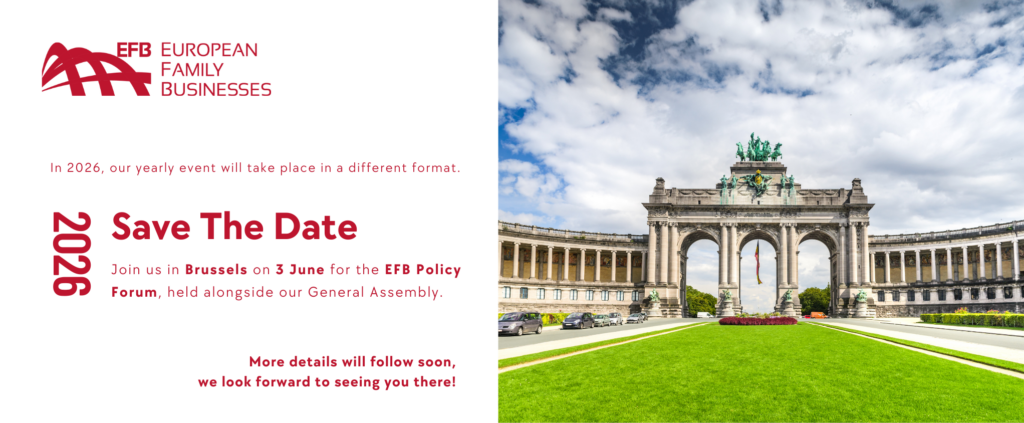
EFB Policy Forum – SAVE THE DATE – 3rd JUNE 2026!
Join us in Brussels on 3rd June, 2026 for our Policy Forum. This event will replace the Summit this year.
More details will follow soon, but please save the date.
Article by External Stakeholder
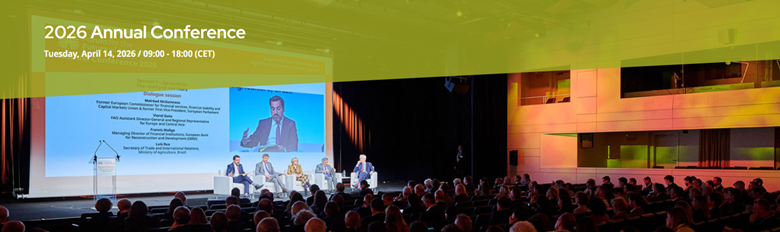
At a Global Crossroads: Rethinking Agriculture and the Environment
At a time of accelerating climate change, geopolitical uncertainty, and mounting pressure on global food systems, Europe’s agricultural future is at a turning point. On 14 April 2026, the Forum for the Future of Agriculture (ForumforAg) returns to Brussels with an Annual Conference designed to confront these challenges head-on, starting with a high impact opening session that sets the tone for the day.
Titled “The End of the World as We Know It: What Are the Consequences for Agriculture and the Environment?”, the opening panel will explore how profound global shifts are reshaping the foundations of agriculture and environmental policy. From climate volatility and resource scarcity to trade disruption and security concerns, agriculture today is no longer simply a sector of the economy, it has become a strategic pillar of Europe’s resilience.
Bringing together senior policymakers, industry leaders, researchers, and civil society voices, this session will examine the agrifood systems approach and its consequences. Rather than treating food production, environmental protection, and economic competitiveness as competing objectives, the discussion will focus on how these elements can be aligned to deliver durable, long-term outcomes.
Central to the debate will be a critical question facing decision-makers and businesses alike: how can the world feed a growing population while restoring the ecosystems that underpin agricultural productivity? And what is Europe’s role in solving this question. The panel will explore what resilience looks like in practice, what trade-offs must be acknowledged, and where innovation, investment, and leadership are most urgently needed.
For family businesses, this opening session and the following sessions offers more than high-level reflection. It provides insight into the policy direction of travel, emerging expectations for sustainability and competitiveness, the broader context in which future business decisions will be made, and solutions to the big challenges of becoming climate positive, financing resilience and supporting a profitable and nature positive Europe.
As Europe looks beyond short-term responses toward long-term stability, the Forum for the Future of Agriculture offers a unique space to engage with the ideas, actors, and debates shaping what comes next, and to connect with market leaders and pioneers of major European sectors.
Register now to be part of the conversation and help shape the future of agriculture and the environment in Europe: 2026 Annual Conference – Forum for the Future of Agriculture
For questions regarding Forum partnership please contact: kyia.kanani@elo.org